WebRTC connection service
Peerovo
Connect browser peers with session-bound tickets, PeerJS signaling, and short-lived TURN credentials.
Peerovo gives browser apps one shared WebRTC connection service. Your backend authenticates people and decides who may join; it exchanges its server-only project key for a peer ticket bound to one project, session, and peer ID. Browsers use that ticket for PeerJS signaling and request ICE settings, including temporary TURN credentials when a direct route is unavailable.
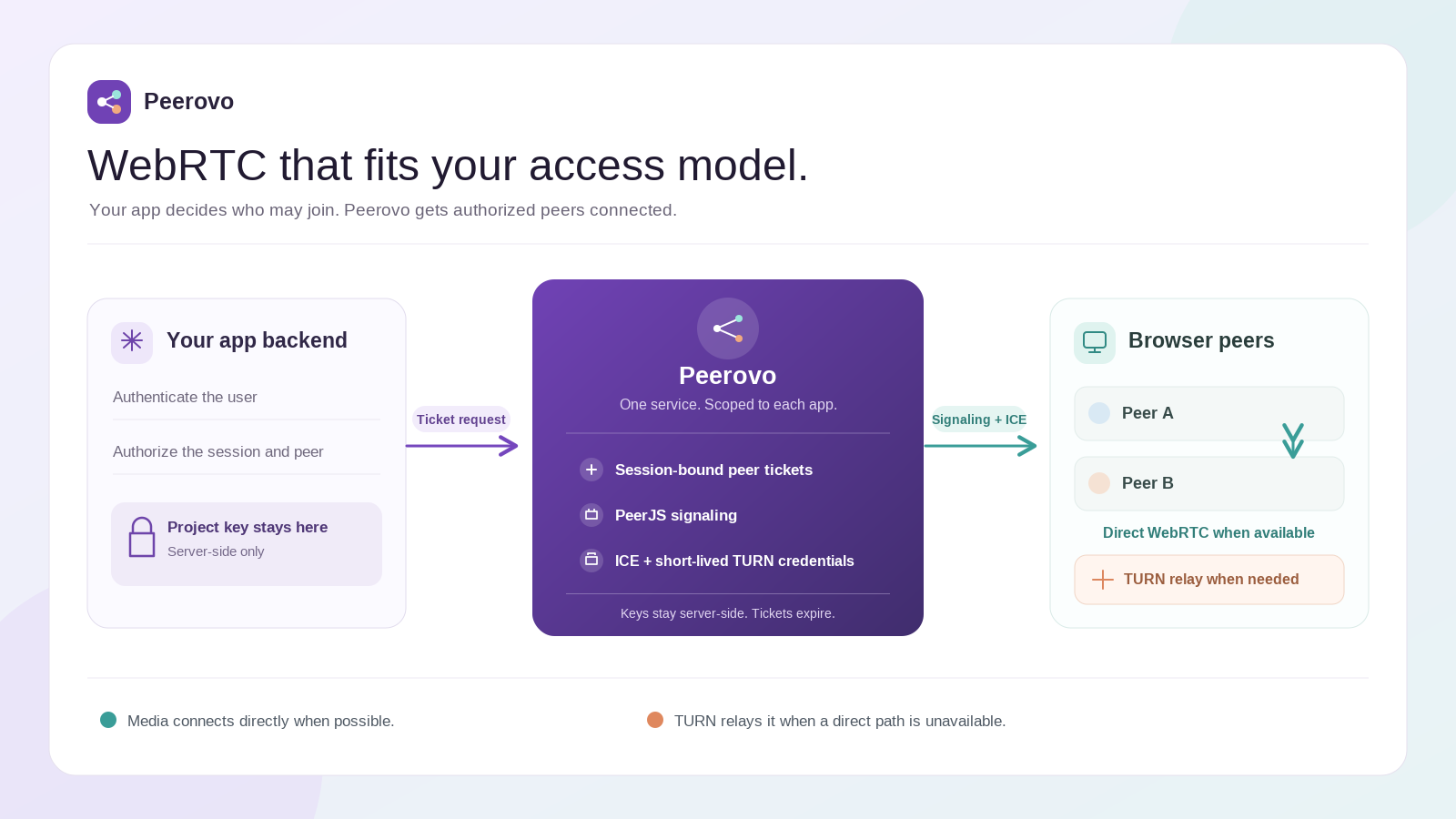
Your app decides who. Peerovo connects the peers.
Keep identity, room membership, and peer naming in your app. Peerovo checks each ticket against the exact project, session, and peer ID, manages signaling admission and capacity, and issues short-lived coturn credentials. Project keys stay on the server, while usage summaries leave out session IDs, peer IDs, and credentials.
Highlights
- Issue signed tickets for an authorized project, session, and exact peer ID
- Keep project API keys on your server while browsers use short-lived peer tickets
- Handle PeerJS signaling and return STUN settings with temporary TURN credentials
- Track service usage without logging session IDs, peer IDs, or credentials
Built with
- JavaScript runtime used for command-line tools and services.
- Node.js web framework used to serve Peerovo’s HTTP API.
- Library that simplifies peer-to-peer WebRTC connections.
- Browser technology for real-time audio, video, and data.
- STUN and TURN server used to help browsers establish WebRTC connections.